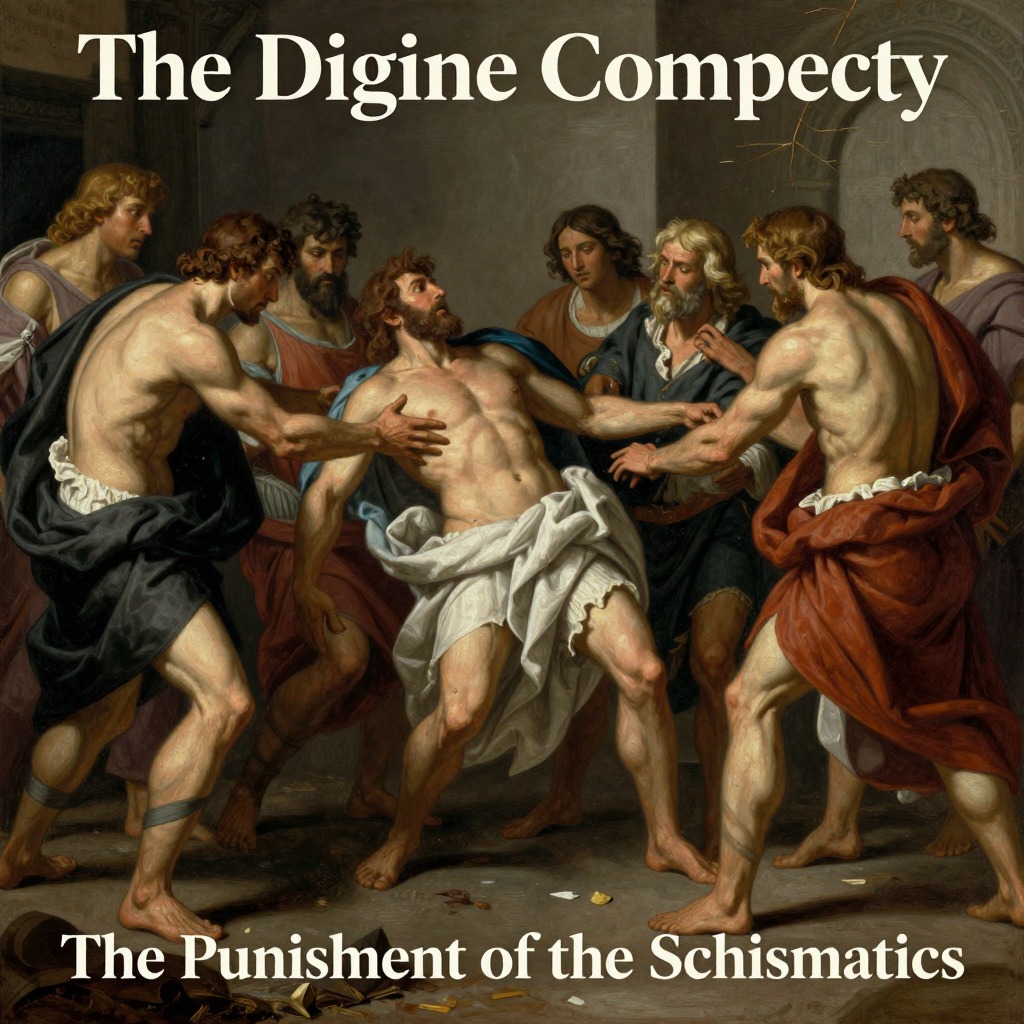
Mahomet and Ali
Mahomet and Ali appear in the Ninth Bolgia of Malebolge, the circle of the Schismatics, where Dante witnesses a punishment of perpetual, violent dismemberment that mirrors the division they caused. Mahomet, the founder of Islam, is split from chin to groin, his entrails hanging between his legs, his heart and the "dismal sack" of his digestive organs visible. He tears open his own bosom with his hands to display his wound, crying out, "See now how I rend me; / How mutilated, see, is Mahomet." Ali, his son-in-law and successor, walks before him, cleft from forelock to chin. The two figures are the first and most prominent among the crowd of schismatics, whom Mahomet explains were "disseminators of scandal and of schism / While living were, and therefore are cleft thus."
The Punishment and Its Mechanism
The torment of Mahomet and Ali operates on a precise, repetitive cycle. A devil stands behind the procession, perpetually wielding a falchion to cleave each sinner anew as they pass. The wounds close again as the shades complete their circuit of the doleful road, so that each time they approach the devil they are whole once more, only to be split open again. Mahomet describes this: "A devil is behind here, who doth cleave us / Thus cruelly, unto the falchion's edge / Putting again each one of all this ream, / When we have gone around the doleful road; / By reason that our wounds are closed again / Ere any one in front of him repass." This endless cycle of healing and re-wounding enacts the contrapasso: those who divided the body of the Church on earth are themselves perpetually divided in Hell.
The Encounter with Dante
When Mahomet notices Dante standing on the crag above, he mistakes him for a condemned soul and asks if he is delaying his own punishment. Virgil explains that Dante is alive and is being guided through Hell for his edification. Upon hearing this, more than a hundred of the tormented shades stop to stare at Dante in wonder, momentarily oblivious to their own torture. Before departing, Mahomet delivers a warning for Dante to convey to Fra Dolcino, a contemporary religious leader whom Dante considered a heretic: "Now say to Fra Dolcino, then, to arm him, / Thou, who perhaps wilt shortly see the sun, / If soon he wish not here to follow me, / So with provisions, that no stress of snow / May give the victory to the Novarese, / Which otherwise to gain would not be easy." This prophecy, like many in the Inferno, blends historical fact with Dante's own political and theological judgments.
Thematic Significance
Mahomet and Ali represent the sin of schism in its most extreme form. By founding a religion that Dante, as a medieval Christian, viewed as a heretical departure from the true faith, they are punished with a bodily division that mirrors the spiritual division they caused. The graphic, almost surgical description of their wounds—Mahomet's exposed entrails, Ali's face split in two—emphasizes the visceral horror of their punishment. The pair also serve as a narrative bridge: Mahomet's warning about Fra Dolcino connects the cosmic justice of Hell to the specific political and religious conflicts of Dante's own time, reminding the reader that the poem's moral framework applies not only to ancient figures but to contemporary events as well.